What a Florida Gas Station Business Is Worth Without the Real Estate

Most gas station owners in Florida do not own the dirt. They operate on a lease, sometimes from a landlord they have never met, sometimes from a family member, sometimes from the fuel supplier. When those owners ask me what their station is worth, they are almost always looking at the wrong numbers.
They have seen the headlines about Florida stations trading at 5% cap rates and 8x EBITDA. Those numbers are real. They just describe a different asset. A corporate-leased Wawa is a real estate investment. A station sold together with its land is two assets in one. A station on leased land is a business, and the market prices it that way.
This post is for the operator selling a business on leased land, and for the buyer trying to figure out what that business is worth.
The Range: 1.5x to 3.0x EBITDA, Plus Inventory
In Florida, a gas station sold without the real estate typically trades at 1.5x to 3.0x EBITDA. Where a specific station lands depends on what is being sold:
| What Is Being Sold | Typical Multiple |
|---|---|
| C-store only (no fuel, no real estate) | 1.5x – 2.0x EBITDA |
| Fuel + c-store (no real estate) | 2.0x – 3.0x EBITDA |
| Fuel + c-store + real estate (for comparison) | 7.0x – 9.0x EBITDA |
The business-only price does not include inventory. Fuel in the tanks and merchandise on the shelves are counted at closing, usually by a third-party inventory service, and paid for at cost on top of the purchase price. On a busy station that can add a meaningful amount to the check at closing, and it is a common point of confusion when a seller compares offers.
In dollar terms, business-only deals in Central Florida have recently been trading in roughly the $179K to $450K range. Compare that with the $3.7M to $7.5M premium branded sites that include the real estate, and you can see why the question “do you own the land?” is always the first one a broker asks. We walked through that spread in detail in What Central Florida Gas Stations Are Actually Selling For in 2026.
Why the Multiple Is So Much Lower Without the Land
It is tempting to read 1.5x to 3.0x as the market undervaluing your business. It is not. It reflects what the buyer actually receives.
When a buyer purchases a station with its real estate, the real estate portion is valued off a cap rate of roughly 6% to 8%. That works out to a 12.5x to 16.6x multiple on the real estate share of the earnings, and blending it with the business gets you to about 8x. The 2026 valuation guide breaks that blend down step by step.
Without the land, none of that applies. The buyer is paying for a stream of earnings that exists only as long as the lease does. They take on the operating risk, the staffing, the supplier relationship, and the landlord, and they need to earn their money back in a few years, not a few decades. A 2x multiple means the buyer expects to recover the purchase price in about two years of earnings. That is what operating risk costs.
SDE vs. EBITDA: Know Which Number Is Being Multiplied
This is where more sellers lose money than anywhere else in the process.
Seller’s Discretionary Earnings (SDE) is the business’s profit with the owner’s own compensation added back: your salary, your health insurance, the family member on payroll who does not really work there, the truck the business pays for. It answers the question, “How much does this business produce for a single owner who runs it?”
EBITDA starts from the same place, then subtracts what it would cost to hire a manager to do the owner’s job. It answers the question, “How much does this business produce if nobody in the ownership works the counter?”
SDE is always the larger number. So a buyer who says “we’re paying 2.5x” has told you very little until you know whether it is 2.5x SDE or 2.5x EBITDA. On a single-store deal the difference can easily run to six figures.
A Worked Example
A hypothetical fuel-and-c-store operation on leased land in Central Florida, with numbers chosen to keep the math simple:
| Line | Amount |
|---|---|
| Net profit on the tax return | $150,000 |
| Add back: owner’s salary and benefits | $75,000 |
| Add back: depreciation and interest | $15,000 |
| SDE | $240,000 |
| Less: market cost of a full-time store manager | ($60,000) |
| EBITDA | $180,000 |
At the Florida business-only range of 1.5x to 3.0x EBITDA, this business is worth roughly $270,000 to $540,000, plus inventory at closing. A well-documented station with a long lease and strong inside sales lands toward the top. A station with a short lease and messy books lands toward the bottom, or does not sell at all.
Now suppose a buyer offers 2.0x and you assume they mean EBITDA. That is $360,000. If they meant SDE, the offer is $480,000, and those are two very different deals. Get the basis in writing before you compare offers.
Get a free station valuation in 48h → Send us the P&L, the lease, and fuel volume. We come back with SDE, EBITDA, and a realistic range.What Moves You to the Top of the Range
Two stations with identical EBITDA can sell a full turn apart. These are the factors that decide which end of the range you land on.
1. The lease
On a business-only sale, the lease is the most important document in the deal. A buyer is purchasing the right to operate at that location for however long the lease allows, and they will read it before they read your P&L.
- Remaining term. Lenders generally want the remaining lease term, including renewal options, to at least cover the length of the loan. For an SBA business-acquisition loan that is typically 10 years. A lease with four years left narrows the buyer pool to cash buyers, and cash buyers pay less.
- Assignment. Can the lease be assigned to a buyer, and on what terms? Landlord consent that “shall not be unreasonably withheld” is very different from consent at the landlord’s sole discretion.
- Rent and escalations. Rent that is high relative to sales comes straight out of EBITDA, and escalations that outpace the business’s growth compress the multiple.
If your lease is short, the most valuable thing you can do before listing is often to negotiate an extension or add renewal options. Nothing else on this list moves the number as much.
2. Inside sales
Fuel brings customers in. The store is where the money is made. Across the industry, the convenience store accounts for roughly 30% of revenue but about 70% of the profit. A buyer looking at two stations with the same fuel volume will pay more for the one with a real food program, coffee, beer and wine, and a documented inside-sales trend going the right direction.
3. The fuel supply agreement
Buyers will ask for the supply agreement early. They want to know whether it can be assigned, how much term is left, what the pricing and rebate terms look like, and whether leaving the brand early would trigger repayment of branding incentives. A clean, assignable agreement with reasonable terms is a selling point. An agreement with a large unamortized incentive balance is a negotiation.
4. Books that match the tax returns
Buyers pay for earnings they can verify, and lenders only finance earnings that show up on the tax return. If the business produces more cash than it reports, that extra cash is worth nothing at sale. Clean monthly P&Ls, POS reports that tie to deposits, and fuel invoices that match reported gallons are what let a buyer pay the top of the range with confidence.
5. Compliance and equipment condition
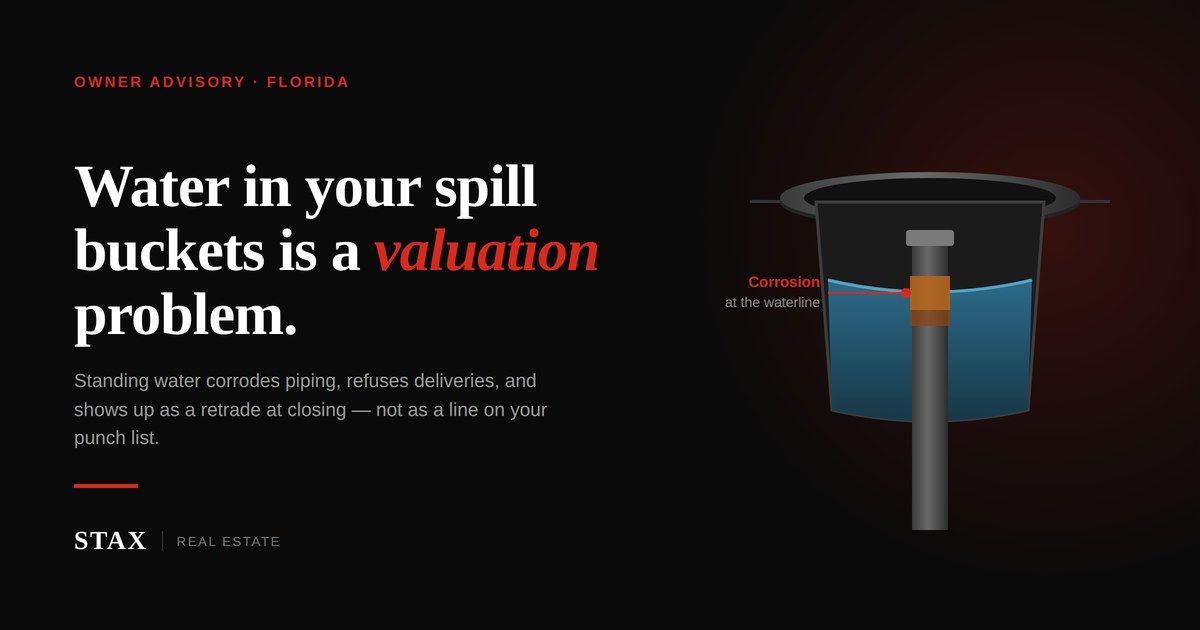
On a leased site, the buyer will want to know who owns the tanks and who is responsible for them under the lease, and they will look at your compliance history with the Florida DEP. A station that has been maintained, with records to show it, avoids the price cut that usually follows a bad inspection. We covered one common example in Water in Your Spill Buckets Is a Valuation Problem.
Selling? See how STAX runs a confidential process → Your business goes to a vetted buyer list, not a public listing board. Your employees and customers don't find out from a sign.Multi-Store Operators Are a Different Market
Everything above applies to a single store or a small group. Once an operator is producing around $2M or more in EBITDA across several sites, the buyer pool changes. Private equity groups and regional consolidators start competing, and platform-grade operations have been trading at 6x to 8x EBITDA plus the real estate. If that describes you, you are not selling a station. You are selling a platform, and the process looks very different.
If You Could Buy the Land, Look at That First
One more option most business-only sellers never consider: if your landlord would sell you the real estate, buying it before you go to market can change the whole deal. A station sold with its land trades in the 7x to 9x range, not 1.5x to 3.0x. Whether that makes sense depends on the price, your financing, and your timeline, but it is worth one conversation before you list.
The Bottom Line
A Florida gas station on leased land is worth 1.5x to 3.0x EBITDA, plus inventory at cost. Where you land in that range comes down to your lease, your inside sales, your supply agreement, and your books, roughly in that order.
Know your SDE and your EBITDA before anyone makes you an offer, confirm which one the buyer is multiplying, and if your lease is short, fix that first.
What Is Your Business Actually Worth?
If you operate a gas station or c-store in Florida and want a real number, send me your P&L, your lease, and your fuel volume. I will tell you where you land in the range and what would move you higher.
Keep going
Former CEO of a dozen-location gas station operating company. 250+ properties sold and leased. Specializing in NNN gas station brokerage, sale-leasebacks, and investment sales across Florida and the Southeast.