How to Buy a Florida Gas Station in 2026 and Capture 100% Bonus Depreciation
A buyer who closes on a Florida gas station and puts it in service by December 31, 2026 can deduct most of the non-land, non-goodwill purchase price on the 2026 federal return. Two rules make that possible: 100% bonus depreciation was restored permanently for property acquired after January 19, 2025, and a qualifying gas station building is 15-year property, which is bonus-eligible.
The work is in three places: closing on time, allocating the price correctly, and holding the asset in a structure where the owners can actually use the loss.
This is written for investors and for the CPAs, attorneys, and bookkeepers on the buyer’s team. If you want the broader case for gas stations as a tax strategy first, start with why accredited investors are flocking to gas stations in 2026.
Not tax or legal advice. This is a broker’s walkthrough. Every figure is illustrative. The buyer’s CPA and attorney decide eligibility, structure, and elections, and a cost segregation study should support the allocation.
The Example Deal
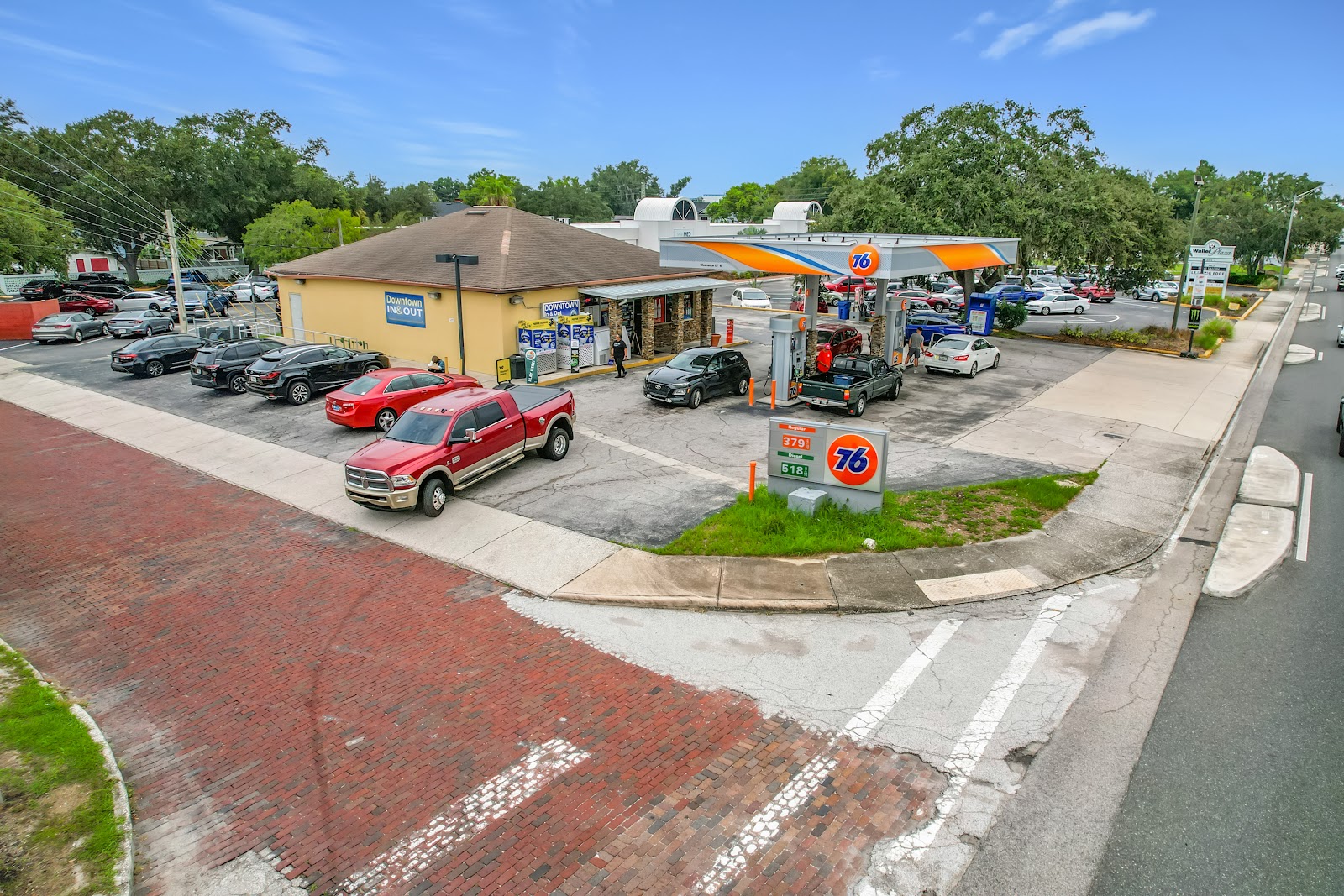
The example is a hypothetical major-brand station in Central Florida, priced at $5,000,000 for the real estate and the business together. The figures are chosen to make the math easy to follow.
| Item | Assumption |
|---|---|
| Price | $5,000,000, fee simple plus business, all-in |
| Fuel | 10 multi-product dispensers (MPDs), $25,000 each = $250,000 |
| Building | Large convenience store with coolers, food service, POS |
| Other improvements | Canopy, USTs and piping, paving, lighting, signage |
| Brand | Supplied under an existing branded fuel supply agreement |
| Buyer entity | New Florida LLC owned by investors, taxed as a partnership |
| Financing | 75% loan ($3.75M), 25% equity ($1.25M) plus closing costs |
| Target | Close and operate by mid-December 2026 |
Depreciation is taken on the full cost basis, including the borrowed portion. That is why the year-one deduction can be larger than the cash the investors put in.
How Bonus Depreciation Works for a Gas Station in 2026
Bonus depreciation lets a buyer deduct 100% of the cost of qualifying property in the year it is placed in service, instead of spreading it over its recovery life. Qualifying property is tangible property with a recovery period of 20 years or less. Land never qualifies, and goodwill is amortized over 15 years under Section 197 with no bonus.
The 2026 rules in plain terms:
- Rate: 100%, made permanent by the One Big Beautiful Bill Act (signed July 4, 2025) for property acquired after January 19, 2025. IRS Notice 2026-11 (January 14, 2026) confirmed the framework.
- Acquisition date: a written binding contract signed before January 20, 2025 keeps the old phase-down rate. A 2026 LOI and contract is clean.
- Used property qualifies if the buyer (and related parties) never used it before. A resale between related parties does not.
- Placed in service: the deduction lands in the year the property is ready and available for its use. A station operating the day after closing is in service that day.
- Automatic unless you opt out: bonus applies by default. The CPA can elect out by asset class on Form 4562 if the loss would be wasted.
Why gas stations are special: the retail motor fuels outlet rule
Most commercial buildings are 39-year property and get no bonus on the structure. A building that qualifies as a retail motor fuels outlet is 15-year property under IRC Section 168(e)(3)(E)(iii), so the building itself is bonus-eligible. Under long-standing IRS guidance, a property generally qualifies if it meets any one of these tests:
- 50% or more of gross revenue comes from the sale of petroleum products, or
- 50% or more of the floor space is devoted to petroleum marketing, or
- The building is 1,400 square feet or less.
A large c-store usually fails the floor-space test, so the revenue test does the work. Fuel is typically well over half of gross sales at a 10-MPD station, but the CPA should confirm it from the seller’s P&Ls and the first year of the buyer’s own books. The test is applied by the owner of the property, so structure matters (see the traps below).
If the building does not qualify, a cost segregation study still carves out the 5-, 7-, and 15-year pieces (dispensers, USTs, canopy, paving, coolers, POS, signage). Those get 100% bonus; the remaining building shell is depreciated over 39 years.
Sources: IRS, Notice 2026-11 announcement · RSM on OBBBA bonus depreciation · Warren Averett on acquisition-date rules
The Numbers on a $5M Station
If the station qualifies as a retail motor fuels outlet, roughly $3.05M of the $5M price is deductible in 2026. If it does not, cost segregation still gets roughly $1.73M. The allocation below is illustrative; the real one comes from an appraisal and a cost segregation study, and both parties sign it into the contract.
Purchase price allocation (illustrative)
| Asset | Allocated ($) | Recovery life | Bonus-eligible? |
|---|---|---|---|
| Land | 1,250,000 | Not depreciable | No |
| C-store building | 1,650,000 | 15-yr if retail motor fuels outlet, else 39-yr | Yes if 15-yr |
| Canopy, USTs, piping, paving, lighting, signage | 900,000 | 15-yr (some 5-yr) | Yes |
| 10 MPDs at $25,000 each | 250,000 | 5-yr | Yes |
| Coolers, food service, POS, shelving, other FF&E | 250,000 | 5- to 7-yr | Yes |
| Goodwill, brand/supply contract value, licenses | 600,000 | 15-yr (Section 197) | No |
| Inventory (fuel and merchandise) | 100,000 | Cost of goods sold | No |
| Total | 5,000,000 |
Year-one deduction under two scenarios
| Scenario A: qualifies as retail motor fuels outlet | Scenario B: 39-yr building, cost segregation | |
|---|---|---|
| Building bonus | 1,650,000 | 330,000 (20% reclassified) |
| Site improvements bonus | 900,000 | 900,000 |
| MPDs bonus | 250,000 | 250,000 |
| FF&E bonus | 250,000 | 250,000 |
| Total 2026 bonus deduction | 3,050,000 | 1,730,000 |
| Building left to depreciate | 0 | 1,320,000 over 39 yrs (~$33,800/yr) |
| Goodwill amortization | ~$40,000/yr for 15 yrs (prorated from closing month) | Same |
| Illustrative federal tax value at 37% | ~$1,128,000 | ~$640,000 |
Leverage effect. The investors put in about $1.25M of equity plus roughly $150K of closing costs. In Scenario A the 2026 deduction is about 2.2 times the cash invested, because depreciation runs on the full basis, loan included. Whether each investor can use that loss is a separate question (see the traps below).
Why the allocation matters so much. Every dollar moved from land or goodwill into building and equipment becomes a 2026 deduction. The IRS and the seller both have a stake in that split, so it must be defensible, documented, and identical on both parties’ Form 8594.
See current gas-station listings →The Process, Step by Step
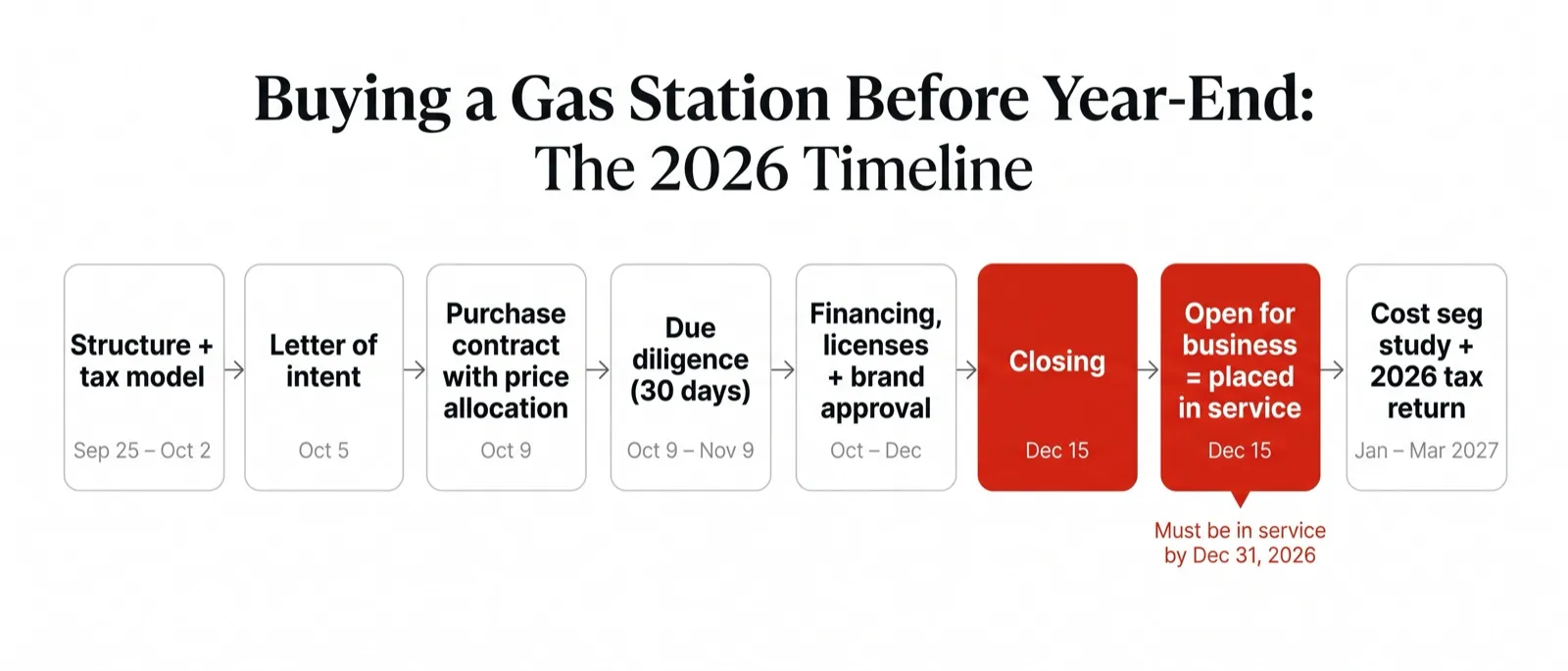
Starting September 25, 2026, there are about 14 weeks to close and operate before year-end. Plan to close by December 15 and treat everything after that as buffer, not schedule.
| Target date | Milestone |
|---|---|
| Sep 25 – Oct 2 | Team engaged, entity formed, tax model run |
| Oct 5 | LOI signed |
| Oct 9 | Purchase and sale agreement signed |
| Nov 9 | Due diligence ends, deposit goes hard |
| Nov 20 | Loan commitment |
| Dec 1–10 | Licenses issued, brand and supply assignment approved |
| Dec 15 | Closing and first day of operation |
| Dec 31 | Hard deadline for placed in service |
| Jan–Mar 2027 | Cost segregation report final, 2026 returns and K-1s |
Each step depends on the one before it; licenses and brand approval run in parallel with diligence so they don’t hold up closing.
Step 1. Build the team and the structure (week 1)
- Form the buying entity (typically a Florida LLC taxed as a partnership) and get an EIN.
- Decide on one entity or two: a PropCo that owns the real estate and an OpCo that runs the store. This changes who meets the retail motor fuels outlet test and how losses flow.
- CPA runs the tax model: each investor’s expected loss, passive/active status, at-risk basis, and whether bonus should be elected out for any class.
- Line up the lender early. SBA 7(a) loans often take 60–90 days, which is tight for a December close; a bank or seller-carry note may be faster. (More on the options in funding choices for gas station purchases.)
- Order a cost segregation pre-analysis so the price allocation in the contract is backed by a professional estimate.
Step 2. Letter of intent (by Oct 5)
- Price ($5,000,000), deposit, due diligence period (30 days), and closing date (on or before December 15, 2026).
- State that price will be allocated among land, building, improvements, equipment, inventory, and goodwill, with the allocation attached to the contract.
- Condition the deal on assignment of the fuel supply agreement (or a new supply deal), transfer of licenses, and access to fuel and sales records.
- Inventory counted at closing and paid separately at cost.
Step 3. Purchase and sale agreement (by Oct 9)
- Attorney drafts an asset purchase agreement covering both real estate and business (or a Florida commercial contract plus a business asset addendum).
- Attach the agreed allocation schedule. Both sides file the same numbers on IRS Form 8594.
- Include environmental representations, indemnity for pre-closing contamination, and access for a Phase I.
- Address Florida sales and use tax exposure on the transfer. Florida can hold a buyer liable for a seller’s unpaid taxes, so require a Department of Revenue clearance or an escrow holdback.
- Sign the contract only after the entity exists, so the right owner is the acquirer.
Step 4. Due diligence (Oct 9 – Nov 9)
- Financials: 2–3 years of P&Ls, tax returns, fuel gallons by month, inside sales, lottery and ATM income. The CPA uses this to confirm fuel is over 50% of gross revenue.
- Environmental: Phase I ESA (ASTM E1527-21), FDEP storage tank registration and compliance history, tank and line install dates, leak detection records, pollution liability insurance. Order a Phase II if the Phase I flags anything. (See compliance and regulations for gas station real estate.)
- Title and survey: title commitment, ALTA survey, zoning confirmation, easements, access points.
- Physical: property condition report on canopy, dispensers, tanks, roof, HVAC, coolers.
- Contracts: supply agreement terms, remaining term, unamortized brand incentives that could be clawed back, equipment leases, POS and card-processing agreements.
- Cost segregation: engineer’s site visit so the allocation reflects the actual components.
Step 5. Financing, licenses, and brand approval (Oct – Dec, in parallel)
- Loan: appraisal, environmental sign-off, commitment by about November 20.
- Brand: brand / jobber approval of the buyer and assignment of the supply agreement.
- Licenses and permits (apply early; some take weeks): Florida sales tax registration, beer and wine license transfer (DBPR), tobacco permit, Florida Lottery retailer application, FDACS food permit and dispenser (weights and measures) registration, county/city business tax receipt, FDEP tank registration update after closing.
- Insurance: property, general liability, liquor liability, and UST pollution liability bound to start at closing.
- Operations: POS, card processing, fuel ordering, and employee transition ready for day one.
Step 6. Closing (target Dec 15)
- Deed, bill of sale for equipment, assignment of contracts and intangibles, closing inventory count.
- Florida closing costs to budget: documentary stamp tax on the deed ($0.70 per $100 of real property value, customarily seller-paid), plus stamp tax on the note ($0.35 per $100) and intangible tax on the mortgage (0.2%), customarily buyer-paid. On a $3.75M loan that is about $13,125 and $7,500.
- Keep the station open through closing so there is no gap in operation.
Step 7. Placed in service (closing day)
- The station sells fuel and merchandise under the new owner the day of or day after closing. That date is the placed-in-service date.
- Document it: first-day sales report, fuel delivery, utility transfers, license effective dates.
- If a remodel or rebrand is planned, keep the station operating; do not close it for work before December 31.
Step 8. After closing (Jan – Mar 2027)
- Cost segregation report finalized; fixed asset register built from it.
- Both parties file Form 8594 with the 2026 returns.
- Partnership return and K-1s (due March 15, 2027, extendable) pass the loss to investors.
- CPA confirms the retail motor fuels outlet test using the buyer’s own first-year revenue and keeps the support in the file.
Who Does What
Each advisor owns a different piece; the deduction fails if any one piece is missed.
| Role | Owns | Key questions to answer |
|---|---|---|
| Investors | Capital, ownership %, participation level | Am I active or passive in this business? Do I have passive income to absorb the loss? Am I personally guaranteeing the loan? |
| CPA | Tax model, allocation, retail motor fuels outlet test, elections, returns | Does the building qualify as 15-year? Elect out of bonus for any class? How are losses allocated in the operating agreement? What is the recapture exposure on exit? |
| Cost segregation firm | Engineering-based allocation of building and site costs | Which components are 5-, 7-, 15-, and 39-year? |
| Attorney | Entity, operating agreement, purchase agreement, title, environmental, closing | Is the allocation in the contract? Are environmental indemnities and tax clearance covered? Do loss allocations have substantial economic effect? |
| Bookkeeper | Fixed asset register, inventory, day-one books | Is every asset tagged with cost, class, and placed-in-service date? Is the opening inventory separated from depreciable assets? Are fuel and inside sales tracked separately to prove the revenue test? |
| Lender | Loan terms, appraisal, environmental approval | Recourse or nonrecourse? Who guarantees? Timeline to commitment? |
| Broker | Deal, seller records, schedule | Are the P&Ls, fuel reports, tank records, and supply agreement in hand? Is the seller on board with the allocation and a December 15 close? |
Traps and Limits to Raise With Your CPA and Attorney
A big deduction on paper is worth nothing if the owner can’t use it or the IRS unwinds it. These are the questions that decide that.
- Passive activity rules. Investors who don’t materially participate in running the store generally can only use the loss against other passive income. Unused losses carry forward and release on sale.
- At-risk and basis limits. An investor can only deduct losses up to their basis and amount at risk. Personal guarantees and recourse debt affect this, so loan structure matters.
- Excess business loss cap. Non-corporate owners can only offset a limited amount of non-business income with business losses each year (indexed annually); the excess becomes an NOL carryforward.
- PropCo / OpCo structure. If one entity owns the real estate and leases it to a separate operating company, the CPA must confirm how the retail motor fuels outlet test applies and how self-rental rules treat the rent and losses. Decide this before signing the contract.
- Depreciation recapture on exit. Bonus taken now is largely paid back on sale: equipment is recaptured as ordinary income, and building depreciation above straight-line can be too. Model the exit, or plan a 1031 exchange into the next station.
- Price allocation scrutiny. An allocation that pushes too little to land or goodwill invites audit. Use an appraisal and a cost segregation study, and file matching Form 8594s with the seller.
- Related-party and prior-use rules. No bonus on property bought from a related party or previously used by the buyer.
- Placed-in-service slippage. A closing that slides to January, or a station that is shut for remodel through year-end, pushes the deduction to 2027.
- State tax. Florida has no personal income tax, but Florida’s corporate income tax does not follow federal bonus depreciation (it is added back and recovered over several years). Investors living in other states may face their own add-backs.
- Interest deduction limit. Large acquisition debt can run into the Section 163(j) business interest cap; the CPA should test it.
- Electing out. If the investors can’t use the loss for years, electing out of bonus for some classes and taking regular depreciation may produce more value over time.
Document Checklist for the Tax File
Keep these together; they are what supports the 2026 deduction if the IRS asks.
- Executed purchase agreement with the signed price allocation schedule
- Appraisal (land vs. improvements) and cost segregation report
- Form 8594 filed by buyer and seller with matching numbers
- Closing statement, deed, bill of sale, assignment of contracts and intangibles
- Evidence of placed-in-service date: first-day sales report, fuel delivery, license effective dates
- Seller P&Ls and buyer first-year books showing fuel share of gross revenue (retail motor fuels outlet support)
- Fixed asset register with cost, class life, and placed-in-service date per asset
- Closing inventory count, booked separately from depreciable assets
- Operating agreement with loss allocation provisions
- Loan documents and any personal guarantees (at-risk support)
- Phase I ESA, FDEP tank records, and pollution liability policy
- Florida DOR tax clearance or escrow documentation
- Form 4562 with any elections out of bonus depreciation
Fourteen weeks is enough time to buy a station and put it in service before year-end — but only if the search, the structure, and the tax model start now rather than in November. If you’re looking for a Florida station that can close on that schedule, see current listings or reach out directly. And if you want a read on what a specific station is worth before you write an LOI, the 2026 gas station valuation guide covers how cap rates and EBITDA multiples are set.
Keep going
Former CEO of a dozen-location gas station operating company. 250+ properties sold and leased. Specializing in NNN gas station brokerage, sale-leasebacks, and investment sales across Florida and the Southeast.